Where Your Donated Clothes Actually Go
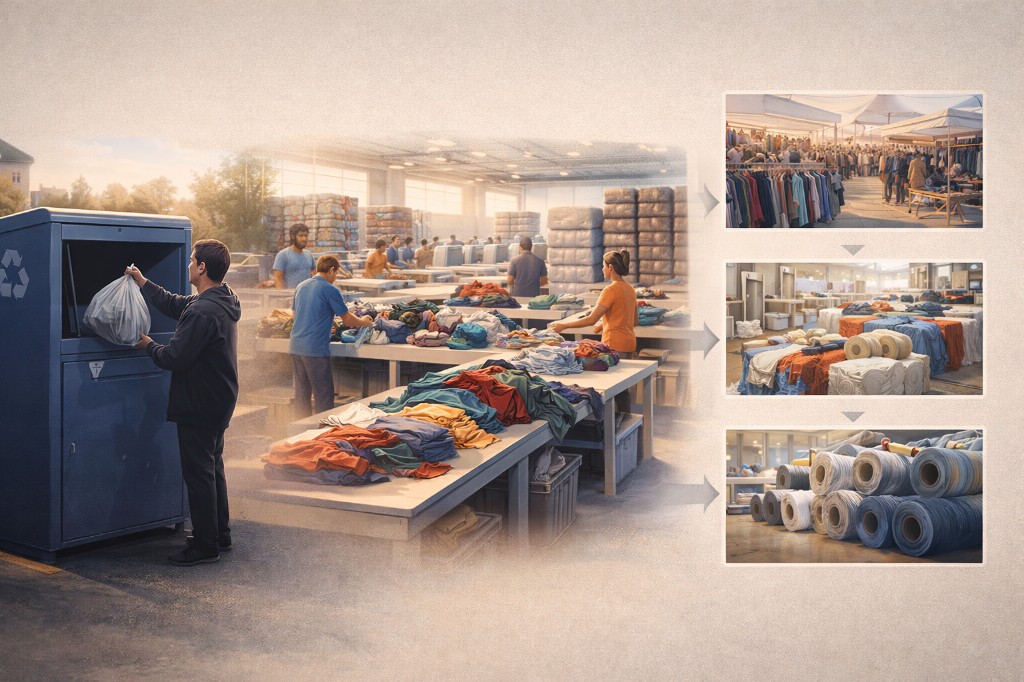
You bag up some old clothes, drop them in a donation bin, and move on with your day. Most people assume the story ends at a thrift store rack or a shipping container headed overseas. The reality is more interesting — and a lot more productive.
Donated clothing enters a global reuse supply chain built around sorting, grading, and matching each item to the market where it has the most value. A single garment can pass through several hands and cross borders before it's done being useful. Understanding how that supply chain works helps explain why donation is one of the most effective things you can do with clothes you no longer wear.
How big is the problem donation solves?
The EPA's most recent data (2018) puts the scale in perspective:
- The U.S. generated 17 million tons of textile waste that year.
- 11.3 million tons went to landfills — about two-thirds of everything produced.
- Only 2.5 million tons were recycled, a 14.7% recycling rate.
According to NIST, each American discards roughly 103 pounds of textiles per year. The Secondary Materials and Recycled Textiles Association (SMART) puts the figure at about 81 pounds per person, representing 6.3% of the total waste stream.
A December 2024 GAO report (GAO-25-107165) — the first federal study specifically on textile waste — found that volume has grown over 50% since 2000 and recommended that Congress direct federal agencies to coordinate on reduction and recycling.
Meanwhile, SMART estimates that 95% of all textiles are reusable or recyclable. The gap between what could be recovered and what actually reaches a landfill is enormous — and that's exactly the gap the donation and reuse industry fills.
What happens at the bin
When you drop a bag at a donation bin or collection point, the clock starts. That bag needs to be picked up before weather, theft, or overflow damages the contents. Collection operators — whether nonprofits, for-profit companies, or charity partners — run scheduled routes to service bins and bring material back to a sorting facility or directly to a buyer.
This is the first fork in the road, and it matters:
- Some material goes to a thrift retailer like Goodwill or the Salvation Army for in-store sorting and sale.
- Some goes directly to a grading facility — either domestically or overseas — as credential clothing.
The path depends on the collector, their partnerships, and what makes the most sense for the volume and quality of material they handle.
Credential clothing: what it means and why it matters
If you've never heard the term, credential clothing is one of the most important concepts in the used textile trade. It refers to donated items that are unsorted, untouched, and still in the original bags the donor packed them in. Nothing has been picked through, graded, or removed.
Why does that matter? Because credential loads are the highest-value product in the wholesale used clothing market. Buyers pay a premium for credential material because:
- It hasn't been cherry-picked. No one has pulled out the designer labels, vintage finds, or quality shoes. The full mix is intact.
- The quality profile is predictable. Credential loads from affluent neighborhoods tend to contain better brands, newer styles, and less wear.
- Graders and sorters want first pick. A grading facility that receives credential bales gets to sort everything themselves and capture the full value spectrum — from cream-grade designer items down to industrial rags.
Companies like Bank & Vogue and Credential Apparel specialize in buying credential clothing from charities and collectors and moving it in trailer loads of 25,000 to 40,000+ pounds to grading operations domestically and around the world.
For collection operators, this means the way you handle material at the bin directly affects its downstream value. Keeping bags intact, preventing contamination, and moving volume quickly preserves the credential grade — and the economics of the entire chain.
How sorting and grading actually work
Whether material arrives as credential bales or pre-sorted lots, it eventually reaches a grading facility — a large operation where workers sort garments by type, condition, season, and destination market. This is where the real supply chain branches out.
The grading tiers
The global used clothing industry uses a standardized grading system:
| Grade | What it means | Where it goes |
|---|---|---|
| Cream | Near-new condition. Minimal wear, designer and premium brands. The top tier. | High-end vintage and resale shops, online resellers, premium export markets like Japan |
| Grade A | Good condition with slight signs of use. Bright colors, limited wear, no significant stains or tears. | Retail resale in domestic and international markets, tropical mix bales for warm-climate countries |
| Grade B | More visible wear. May have minor repairs needed, some fading. Still wearable. | Discount resale, developing markets, outlet channels |
| Grade C | Significant wear. Not suitable for retail resale as-is. | Cut into industrial wiping and polishing cloths, or sent for fiber reclamation |
| Rags / non-wearable | Damaged, stained, or worn beyond reuse as clothing. | Industrial wipers, insulation, carpet padding, fiber recycling |
A single credential bale might yield product across all five grades. That's why credential material commands a premium — the full spectrum is intact.
Sorting categories beyond grade
Within each grade, sorters further divide by category: men's, women's, children's; shirts, pants, dresses, outerwear, athletic wear; summer weight vs. winter weight. One common export product is Tropical Mix — lightweight summer clothing graded for warm-climate markets in Latin America, Africa, and Southeast Asia.
Facilities like those in Karachi, Pakistan or the U.S. sorting operations can produce over 200 distinct categories from a single incoming stream. In Pakistan alone, approximately 809,000 tons of secondhand clothing were imported in 2023, with 280,000 tons re-sorted and re-exported to markets in Africa and beyond.
Where it all goes: the global reuse market
The U.S. exported $847 million worth of used clothing in 2024, according to World Bank trade data. The top destinations tell you where demand is strongest:
| Destination | Value (2024) | Volume |
|---|---|---|
| Guatemala | $179M | 116M kg |
| Chile | $87M | 61M kg |
| Honduras | $79M | 44M kg |
| Mexico | $66M | 33M kg |
| India | $47M | 83M kg |
| Canada | $39M | 74M kg |
| El Salvador | $37M | 25M kg |
| Japan | $33M | 3M kg |
| Nicaragua | $32M | 28M kg |
| Pakistan | $25M | 52M kg |
Guatemala alone accounts for over 20% of all U.S. used clothing exports — receiving nearly all of it from the United States. In these markets, secondhand clothing isn't a consolation prize. It's an affordable, preferred source of quality apparel that supports local retail economies, small vendors, and families.
The destinations reflect the grading system at work: Japan buys low volume at high value (cream and premium grades), while Guatemala and Honduras absorb large volumes of Grade A and B mixed bales for local resale networks.
What happens to clothes that can't be worn again
According to SMART, nearly 100% of collected textiles can be reused or recycled. Their breakdown:
- ~45% reused as apparel — resold domestically or exported
- ~30% converted into industrial wiping and polishing cloths — sorted, bleached, and cut for manufacturing, automotive, and janitorial use
- ~20% processed into fiber for new products — shredded into raw material for insulation, carpet padding, yarn, paper, pet bedding, and furniture stuffing
- ~5% truly unusable — items contaminated by mildew, solvents, or chemicals
SMART members alone keep approximately 1 billion pounds out of landfills annually, generating $3.4 billion in revenue and employing roughly 20,000 people worldwide.
So even the clothes that are too worn or damaged for anyone to wear again still have productive uses. A pair of jeans past its wearable life can become building insulation. A cotton t-shirt that's seen better days becomes a wiping cloth on a factory floor. The material keeps working.
New technology is expanding what's possible
The sorting and recycling side of the industry is advancing quickly:
AI-powered optical sorting
Companies like PICVISA are deploying systems that use near-infrared (NIR) spectroscopy and machine learning to identify fiber composition at industrial speed — roughly one garment per second. This matters because knowing the exact fiber content (cotton vs. polyester vs. blends) determines which recycling pathway each item can follow.
Traditional sorting relies on workers reading care labels and making judgment calls. Automated systems can handle higher volumes, detect blended fabrics that are invisible to the eye, and route material to the right downstream process more accurately.
Fiber-to-fiber recycling
The biggest frontier is true circular recycling — turning old textiles back into new fiber without quality loss:
- Renewcell (Circulose) dissolves used cotton and cellulosic textiles into pulp that fiber producers convert into virgin-quality viscose or lyocell.
- Infinited Fiber transforms cotton-rich textile waste into Infinna™ fiber using a process that can handle blends containing polyester and elastane. Their first commercial factory will produce 30,000 metric tons per year — enough for roughly 100 million t-shirts.
These technologies are still scaling, but they point toward a future where the grade hierarchy extends further: material that today becomes a rag or insulation could eventually become new clothing again.
Why the trash can is the worst option
When clothes go into the household trash, they go straight to a landfill with zero recovery. No sorting, no grading, no second life. And once they're there:
- Synthetic fabrics (polyester, nylon, acrylic — roughly 60% of modern textiles) can take up to 200 years to break down, fragmenting into microplastics that leach into soil and groundwater.
- Even natural fibers like cotton decompose far more slowly than you'd think in the oxygen-free conditions of a modern landfill.
- Decomposing textiles produce methane, a greenhouse gas roughly 80 times more potent than CO₂ over a 20-year window.
The GAO report noted that about 60% of textiles contain microplastics that accumulate in soil and groundwater — a problem that grows with every ton landfilled.
SMART's guidance is simple: if it's dry and free of chemical contamination, it can be reused or recycled. Stained, torn, out of style — none of that matters. It all has a destination in the supply chain. Only wet, mildewed, or solvent-contaminated material is truly unusable.
The first mile makes everything else work
Everything described above — the grading, the global trade, the fiber recycling — depends on reliable collection. When bins overflow, pickups get missed, or donated material sits exposed to weather, it degrades or disappears before it ever reaches a sorting facility. That's material that falls out of the reuse chain entirely.
For the operators, nonprofits, and collection companies running that first mile, the operational basics matter more than anything downstream: servicing bins on schedule, tracking container performance, keeping drivers on efficient routes, and making sure volume flows predictably to downstream partners.
Tools for route optimization, location and container tracking, and field execution with a driver app are how collection operators protect the quality and economics of everything that happens after the bin.
Run a donation or textile collection operation? See how Plutou helps →
Sources
- EPA — Textiles: Material-Specific Data (2018)
- NIST — Your Clothes Can Have an Afterlife
- SMART — Frequently Asked Questions
- GAO-25-107165 — Textile Waste: Federal Entities Should Collaborate (Dec 2024)
- World Bank WITS — U.S. Worn Clothing Exports (2024)
- Bank & Vogue — Credential Used Clothing
- Indetexx — Used Clothing Sorting & Grading Guide
- Renewcell — Technology
- Infinited Fiber — Our Technology